Everyone says they want empowered teams. It's the consensus position in product — and for good reason. Empowered teams move faster, make better decisions, and build better products. I've been banging this drum for over a decade.
But here's what I've noticed in working with organisations of all shapes and sizes: empowerment isn't binary. It's not a switch you flip — as I explored in You Can't Just Flip the Switch on Empowerment. It's a spectrum. And most teams are empowered at a far lower level than their leaders believe.
As Marty Cagan put it in his endorsement of The Decision Stack book: "It's no secret that product model companies depend on empowered product teams. What most people don't understand is that empowered product teams depend on what readers of my content will recognise as the strategic context." That's the bit most organisations get wrong. They declare teams "empowered" without giving them the context they need to make good decisions — and then wonder why nothing improves. The level at which a team is empowered only matters if there's enough strategic context to support it.
The Decision Stack gives us a surprisingly clean way to diagnose exactly where a team sits on that spectrum — and, more importantly, whether that's the right level for their context.
The Empowerment Diagnostic
As a reminder, the Decision Stack connects vision to daily work through five layers: Vision, Strategy, Objectives, Opportunities, and Principles. Each layer answers a question that helps teams make better decisions. But the layer at which a team is empowered to make decisions tells you a lot about how that team actually works.
I've started thinking of this as a simple 0-to-3 scale. Level 0 is a problem. Levels 1 through 3 are all valid — the right level depends entirely on your context. The question isn't "how do we get to Level 3?" It's "are we at the right level, and is it a deliberate choice?"
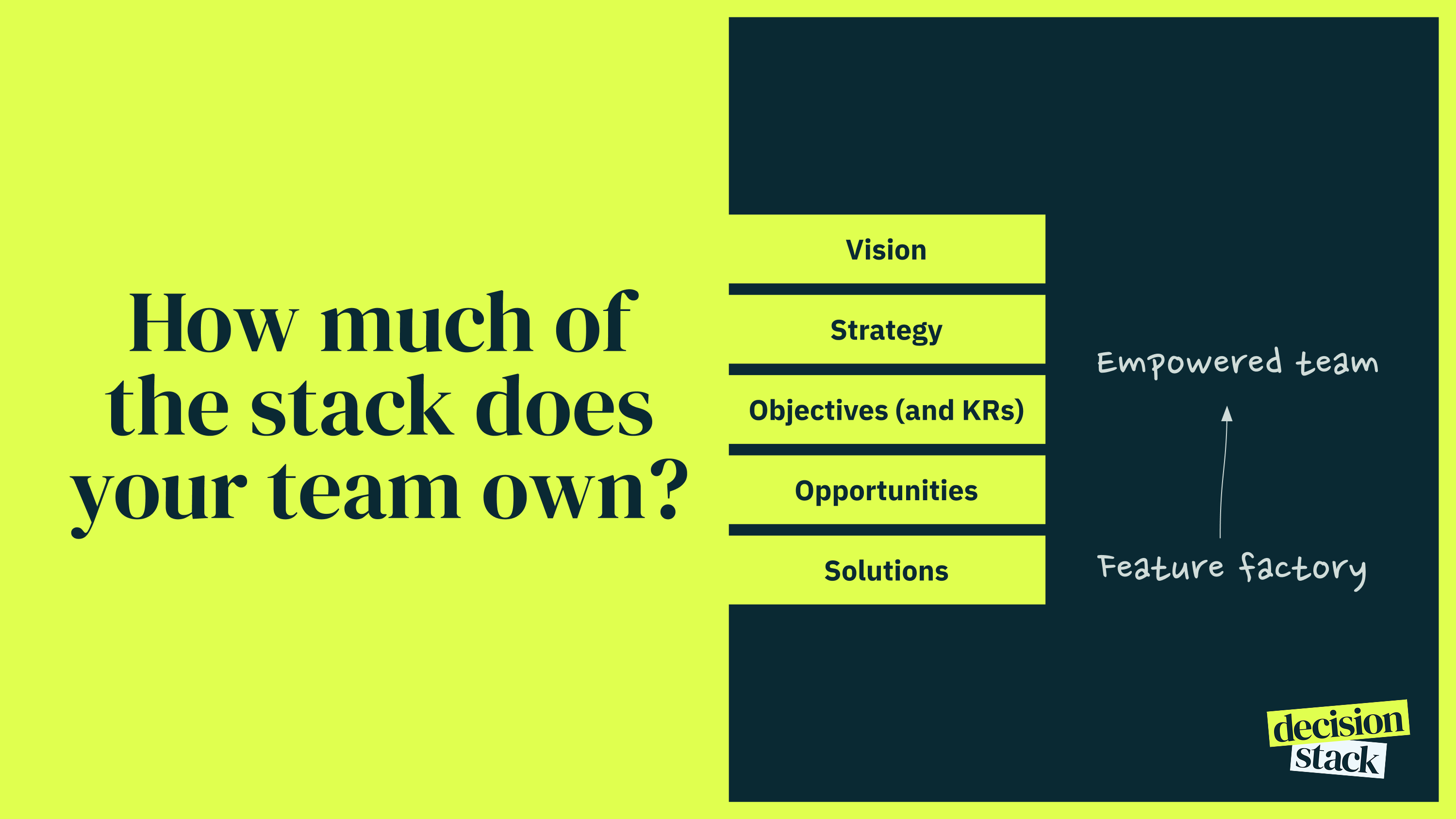
Level 0: Solutions — The Feature Factory
At Level 0, a team is told what to build. They own the how — the technical implementation, the UX details — but nothing above that. Someone else has decided the solution; the team's job is to deliver it.
Here's the thing: solutions aren't even in the Decision Stack. Deciding how to build something isn't a strategic decision — it's a delivery decision. If your team only operates at this level, they're not making decisions about the business at all. They're in a feature factory: high output, low impact, and no connection between their daily work and the bigger picture.
This is the one level that's genuinely problematic. Not because delivery doesn't matter — it absolutely does — but because a team with no ownership above the solution level can't course-correct. They can't say "actually, this isn't the right thing to build" because they don't own the problem space. They can only say "we could build it differently." That's not empowerment, it's execution. And as Roger Martin argues — and I explored in my recent post on his work — the idea that there's "strategy" at the top and "execution" at the bottom is a fiction. There are only decisions at every level. Level 0 teams aren't making meaningful decisions at all.
If your team is at Level 0, that's a red flag. Not because the people aren't capable, but because the system isn't letting them contribute where it matters.
Level 1: Opportunities — Minimum Viable Empowerment
At Level 1, teams own opportunity discovery and prioritisation. They decide what problems to solve and what solutions to try. Someone else has set the objectives, but within those constraints, the team has genuine autonomy over their problem space.
This is the entry point into real product work — and honestly, it's where most "empowered" teams actually sit. And that can be completely fine. A team that genuinely owns its opportunity space can do extraordinary work. They're talking to customers, running experiments, making trade-offs between different problems to solve, and deciding which solutions are worth pursuing. That's meaningful decision-making. As I explored in The Problem with Problems, when teams operate at the Opportunity level, they unlock better product decisions because they're not just reacting to feature requests.
Level 1 is often the right answer for teams in larger organisations where the strategic context is set centrally — and set well. The key word there is "well." If the objectives handed down are clear and meaningful, a Level 1 team can thrive. If they're vague targets like "grow 25%" with no strategic context — well, that's a different problem entirely. I wrote about how to deal with that in From "Grow 25%" to Real Strategy.
Level 2: Objectives — Owning the Outcomes
One step up from Level 1, teams at Level 2 own their own objectives. They're not just deciding what opportunities to pursue — they're deciding which outcomes matter most and how to measure progress against them.
This is a significant shift. A Level 1 team is told "improve activation" and decides how. A Level 2 team looks at the strategy and decides that activation is where they should focus in the first place — and might change that focus next quarter if the data warrants it. They own the "what" of their contribution to the business, not just the "how."
This is where OKRs become genuinely powerful — and genuinely dangerous. When teams own their objectives, OKRs stop being a cascaded to-do list and start being a real tool for strategic alignment. But it also means the team needs enough context to set objectives that actually ladder up to the company strategy. Without that context, you get teams optimising for metrics that don't move the business forward — or worse, that conflict with what other teams are doing.
Level 2 works well when teams have strong strategic context and the maturity to translate that into outcomes. It's more demanding of both the team and the leadership providing that context. If your strategy is clear and well-communicated, Level 2 teams can be incredibly effective. If your strategy is a mess, Level 2 empowerment just distributes the confusion.
Level 3: Strategy — The Fully Empowered Team
At Level 3, teams own their own strategy. They decide where to play and how to win within their domain. This is the highest level of empowerment in the Decision Stack — a team that answers the strategic "how" differently from other teams, as I explored in When to Split Your Decision Stack.
Traditionally, this level of empowerment has been rare — and for good reason. Owning a strategy means owning the market understanding, competitive dynamics, and long-term positioning for your domain. That's a lot of cognitive load for a team that's also building product. It's why Level 3 has historically been the domain of small organisations, startups, or semi-autonomous business units within larger companies. The constraint wasn't capability — it was bandwidth. A team can only oversee and process so much complexity.
But something interesting is happening.
AI and the Expanding Scope of Control
One of the most tangible effects of AI on product teams isn't the code it writes — it's the scope of what a small team can manage. And the evidence is becoming hard to ignore.
Look at the new generation of AI-native startups. Lovable, the Swedish "vibe coding" platform, hit $200 million in annual recurring revenue in just eight months — with roughly 50 employees. Midjourney generates $500 million in revenue with around 100 people and zero external funding. According to research from Revelio Labs, early-stage tech startups are now raising 50% more money while employing 16% fewer people than five years ago. The top AI-native startups generate roughly 5-6x more revenue per employee than traditional software companies.
These aren't just impressive numbers. They're evidence of a fundamental shift in what a small, focused team can oversee. These companies aren't just building faster — they're managing more complexity with fewer people. More market analysis, more customer insight synthesis, more competitive monitoring, more scenarios, more hypotheses, more testing. The cognitive overhead that used to require large teams or narrow domains is shrinking.
Now think about what it takes for a product team to own a strategy. They need deep market understanding. They need to monitor competitive dynamics. They need to synthesise customer research at a pace that keeps up with their decision-making. They need to model trade-offs and run scenarios. All of that used to require either a very large team or a very narrow domain.
AI is loosening both constraints.
Marty Cagan made a related point in his endorsement of The Decision Stack book: "as product teams embrace AI to discover and deliver outcomes, the foundation models need this very same context to be genuinely useful — for very much the same reasons." In other words, AI doesn't just expand what teams can do — it also demands the strategic context that makes empowerment work. A team using AI without strategic clarity will just generate more noise, faster. But a team with clear strategic context can use AI to operate at a level of scope and sophistication that simply wasn't possible before.
I'm not making a prediction here — I'm asking a question. If the constraint on strategy-level empowerment was always "a team can only handle so much complexity," and AI is materially expanding that capacity, does Level 3 become accessible to more teams? Could the "fully empowered team" shift from being the exception — reserved for startups and skunkworks projects — to something approaching a new normal?
The implications for org design are fascinating. If every team can own strategy, should they? Not necessarily. As I've argued before, the more teams can share a Decision Stack, the better. Shared context creates compounding alignment. But the option of Level 3 empowerment for more teams changes the calculus of when to split your stack. It's worth paying attention to.
Principles: The Multiplier at Every Level
You'll notice I haven't given Principles their own level. That's deliberate. Principles don't sit at a point on the empowerment spectrum — they amplify empowerment at every level.
A Level 1 team with strong Principles makes better opportunity decisions without escalating. They know how to make trade-offs because the Principles encode the strategic intent behind those trade-offs. A Level 2 team with strong Principles sets objectives that naturally align with the broader strategy, because the Principles provide guardrails that keep them on course.
But a Level 3 team without Principles? That's a team that drifts. They have the autonomy to make strategic choices, but no shared framework for making them consistently. Principles are the connective tissue that makes empowerment work — they're what turns autonomy into aligned autonomy.
As I wrote in Stop Waiting for Permission, Principles can drive strategic thinking from the bottom up. That's true at every level of this diagnostic. Whatever level your team sits at, investing in clear, opinionated Principles will make them more effective there.
Are you at the right level?
So how do you use this? Start by honestly assessing where your team actually sits — not where your leadership deck says it sits, but where real decisions are being made. Ask yourself:
- Who decides what we build? If the answer is "someone outside the team," you're at Level 0.
- Who decides what problems to solve? If the team owns opportunity discovery, you're at least at Level 1.
- Who sets our objectives? If the team sets its own OKRs based on strategic context, you're at Level 2.
- Who decides our strategic direction? If the team owns where to play and how to win in their domain, you're at Level 3.
Then ask the harder question: is this the right level for our context?
Level 0 is almost always wrong — it's the feature factory, and you should be working to get out of it. But everything else is context-dependent. A team in a large, well-aligned organisation with clear strategy might thrive at Level 1. A team operating in a fast-moving market with distinct competitive dynamics might genuinely need Level 3.
The worst outcome isn't being at the "wrong" level. It's being at a level you didn't choose — where the empowerment you have (or don't have) is an accident of org design rather than a deliberate decision about how your team can be most effective.
And here's where transparency matters more than most leaders realise. A huge amount of team frustration comes not from the level of empowerment itself, but from the gap between expectation and reality. Many people hear "empowered team" and assume Level 3 — full strategic autonomy. But in most organisations, Level 1 or 2 is the right answer, and that's genuinely fine. The problem isn't being at Level 1. The problem is being told you're empowered while experiencing Level 1 without anyone acknowledging it. That gap breeds cynicism faster than any amount of feature factory work.
If leaders were transparent about where teams sit and why — "you're at Level 1 because we have a strong central strategy and your job is to own the opportunity space within it" — teams could stop resenting the constraints and start excelling within them. Empowerment isn't about maximising autonomy. It's about clarity on where your decisions matter and enough context to make them well.
Like everything in the Decision Stack, it comes back to making deliberate choices. Empowerment is no different.
So: how empowered is your team, really? And is that a choice — or an accident?