Strategy is a muscle. Like any muscle, it gets stronger with reps. The first time you work through a proper strategy exercise, it might take weeks. The second time, days. Eventually, strategic thinking becomes instinct: something you do naturally when facing a decision, not something that requires a special offsite.
But here's the thing about reps. You don't have to limit them to your own company.
One of the best ways to get better at strategy is to study someone else's. Pick a company you admire and reverse-engineer what you think their strategy is. What's their vision? Where are they playing and how are they winning? What are they saying no to? What tradeoffs have they made?
I've recommended this exercise to hundreds of leaders over the years. It works because it takes the pressure off. When it's your own company, the stakes are high, and the politics are real. When it's someone else's, you can focus purely on the thinking.
The Acquired Podcast: Strategy Reps on Demand
If you're looking for source material, there's no better place to start than the Acquired podcast. Ben Gilbert and David Rosenthal go deep on the stories behind great companies. I'm talking three, four, sometimes five-hour episodes that walk through every major decision a company has made, the context behind those decisions, and what happened as a result.

It's strategy education disguised as entertainment. Every episode is essentially a masterclass in how strategic choices compound over time. You hear how Nike bet everything on athlete endorsements. How Costco decided that limiting SKUs was a feature, not a bug. How LVMH assembled a portfolio of luxury brands by understanding something fundamental about desire and scarcity.
When you listen through the lens of the Decision Stack, these stories come alive in a new way. You start to see the vision that drove the company, the strategic choices that defined their path, the objectives they prioritized, and the principles they used to make tradeoffs. It all connects.
From Listening to Seeing
Here's where it gets really interesting.
My friend Jonny Schneider has built something I'm really excited about. Jonny has spent two decades helping leadership teams turn fuzzy strategic intent into clear action — working with executives across product, design, and engineering to make strategy actually land in the work. (He also wrote Understanding Design Thinking, Lean, and Agile, which still holds up a decade later!)
And now he has built Lunastak, an AI-powered strategy tool that helps you develop and visualize your Decision Stack. It's a conversational tool: you can feed it messy thinking, and it helps you structure that thinking into a coherent stack of decisions, from vision through strategy, objectives, opportunities, and principles.
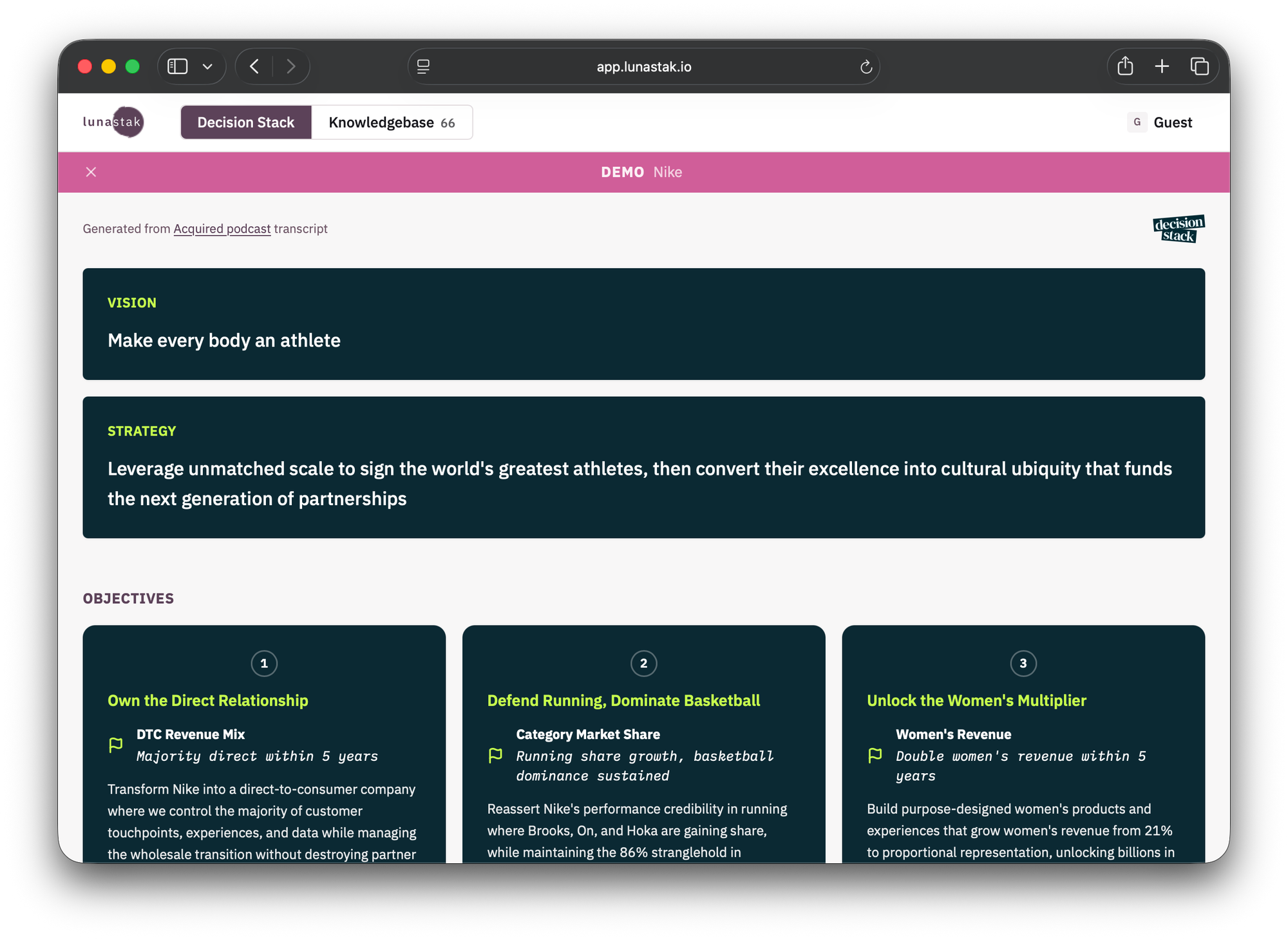
That alone would be worth writing about. But Jonny did something clever. He's used Lunastak to break down Acquired podcast episodes into Decision Stacks — initially as a stress test for the analysis engine at the heart of the product. The results were compelling, and the learning helped him improve it further. What's left is a learning opportunity: you can actually see, laid out visually, how a company like Nike's strategy decomposes into a Decision Stack based on the story told in the Acquired episode.
Instead of just listening to a great story about a company and hoping the strategic lessons stick, you can see the structure underneath. You can see how Nike's vision connects to their strategic choices, how those choices inform their objectives, and what principles guide their decisions.
That's the difference between passive learning and active learning. Between hearing a story and understanding the mechanics of what made it work.
Strategy Reps, Without the Offsite
This is what gets me excited about where strategic thinking is going. For years, the only way to build your strategy muscle was to do the work yourself, in your own company, with all the messiness that entails. Or maybe you'd get lucky and find a great case study in a business school course.
Now you can listen to an Acquired episode on your commute, then open Lunastak and see that same company's strategy laid out as a Decision Stack. You can study how the pieces connect. You can compare it to your own stack. You can start to see patterns across companies and industries.
Jonny used Lunastak to build the strategy for Lunastak itself — about as good a proof of concept as you can get. His thoughts on this experience have stuck with me: *"AI accelerates what's possible. It doesn't replace the thinking."*
There's a flavour of post going around that suggests this stuff is easy now — that with the right prompts, anyone can ship a product in a weekend. Lunastak took hundreds of hours. Most of them went into the slow, curious work of figuring out how decades of expertise might translate into a medium none of us fully understand yet. That's the part that matters, and it's what separates something that demos well from something that actually holds up.
Go explore the Acquired episodes in Lunastak and see what a Decision Stack looks like when it's built from one of the best business podcasts out there. Then try building your own.
Your strategy muscle will thank you.