
Resources
Further reading, tools, and more
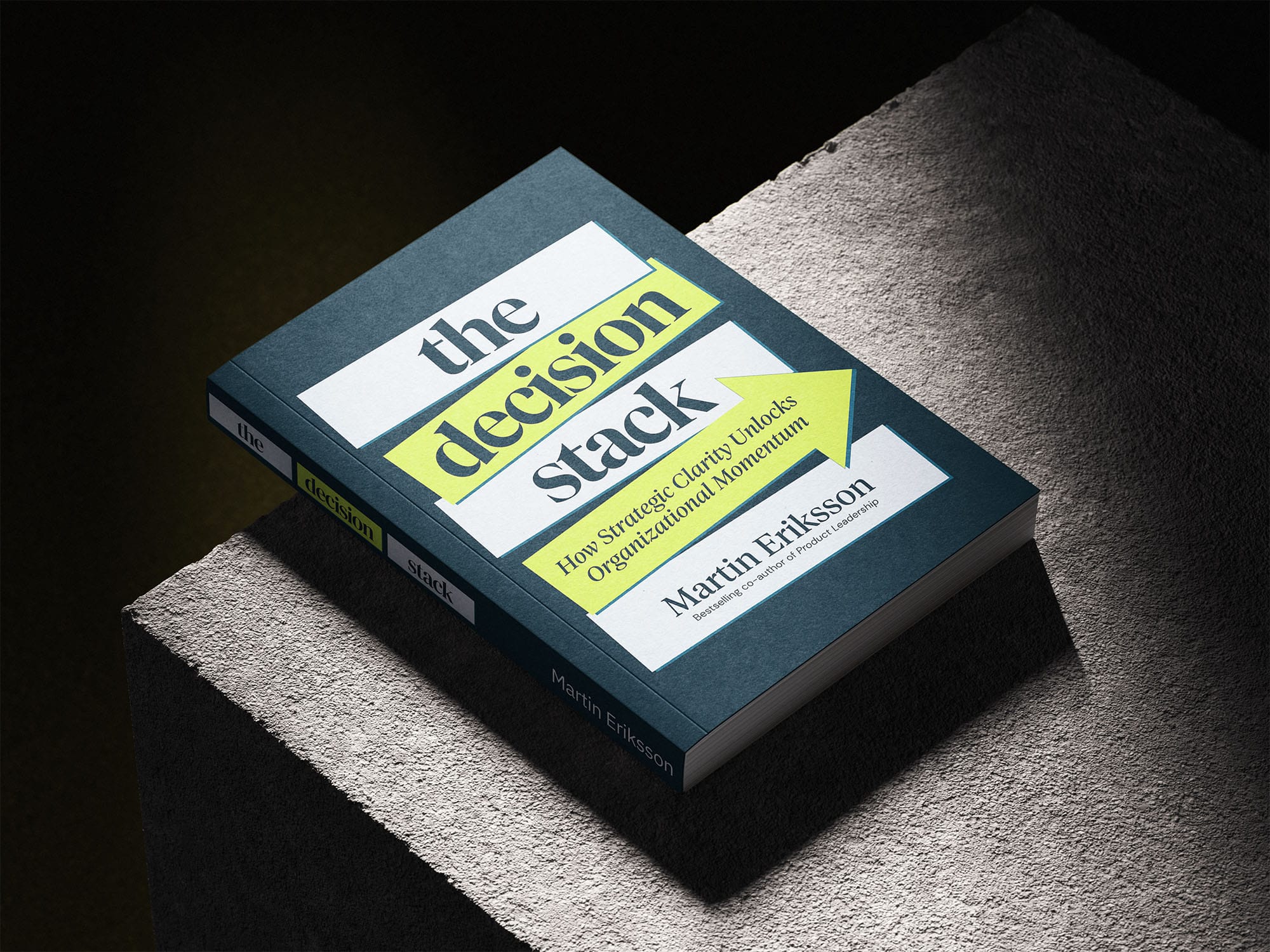
for The Decision Stack
Decision Stack Tools
New
Lunastak
Extract insights from your thinking, documents, and conversations. Lunastak structures them into a Decision Stack — so your strategy stays sharp and aligned.
Try Lunastak NewThis or That
A poll that helps you make decisions on strategic trade-offs. Share it with your team to align on what matters most — and surface disagreements early.
Try This or That
Coming Soon
More Tools
We're building more tools to help you apply the Decision Stack framework. Subscribe to the newsletter to be the first to know.
Further Reading & Toolkits
Chapter 3: Vision and Mission
- Daniel H. Pink, Drive: The Surprising Truth About What Motivates Us — The research behind why purpose, autonomy, and mastery matter more than money for knowledge workers. Essential context for understanding why vision creates motivation.
- James C. Collins and Jerry I. Porras, Built to Last: Successful Habits of Visionary Companies — The landmark study showing that companies with a clear purpose dramatically outperformed the market. The data behind why vision isn't just nice to have.
Chapter 4: Strategy
- A.G. Lafley and Roger L. Martin, Playing to Win: How Strategy Really Works — The definitive guide to strategy as choices about where to play and how to win. The framework I reference most throughout this book.
- Richard Rumelt, Good Strategy/Bad Strategy — Another strategy classic I recommend highly.
- April Dunford, Obviously Awesome: How to Nail Product Positioning so Customers Get It, Buy It, Love It — Why positioning is the core of your strategic bet, not a marketing exercise. Essential reading if you're struggling to make your strategy concrete.
- Hamilton Helmer, 7 Powers: The Foundations of Business Strategy — A rigorous framework for understanding what makes a strategy defensible. Helmer identifies the seven sources of durable competitive advantage, essential for pressure-testing whether your "how to win" will actually hold.
- Rita Gunther McGrath, The End of Competitive Advantage: How to Keep Your Strategy Moving as Fast as Your Business — McGrath argues that competitive advantages are now transient, and that organizations need to learn to move through them rather than cling to them. Essential context for the chapter's emphasis on sequencing, "not now vs no," and strategy as a living practice rather than a fixed plan.
- Bernie Smith, KPI Checklists: Develop Meaningful Key Performance Indicators and Measures — Practical guidance on KPI trees and metric decomposition. Useful when you need to turn a vague growth target into something actionable.
See my full Strategy toolkit for more
Chapter 5: Objectives (and Key Results)
- Christina Wodtke, Radical Focus: Achieving Your Most Important Goals with Objectives and Key Results — The best book on OKRs I've found. Especially strong on the system around the goals: the cadence, the check-ins, the celebrations.
- Jeff Gothelf and Josh Seiden, Who Does What By How Much? A Practical Guide to Customer-Centric OKRs — The best guide to the two-tier OKR structure this chapter builds on. If you're implementing the org-to-team decomposition, start here.
- Josh Seiden, Outcomes Over Output: Why Customer Behavior Is the Key Metric for Business Success — A short, sharp argument for why objectives should describe outcomes, not outputs. The foundation for the certainty-based nuance in this chapter.
- Matt LeMay, Impact-First Product Teams: Define Success, Do Work That Matters, Be Indispensable — A brilliant challenge to the trap of picking easy goals over impactful ones.
- Peter F. Drucker, The Practice of Management — Where Management by Objectives began. Worth reading to understand why goal-setting frameworks keep evolving, and what problems they were originally trying to solve.
Chapter 6: Opportunities (and Solutions)
- Teresa Torres, Continuous Discovery Habits: Discover Products that Create Customer Value and Business Value — The definitive guide to Opportunity Solution Trees and continuous discovery. If you're going to use one tool from this chapter, make it this book.
- Uri Levine, Fall in Love with the Problem, Not the Solution: A Handbook for Entrepreneurs — A powerful argument for problem-first thinking, from the founder of Waze. This chapter builds on Levine's insight and expands it to opportunities.
- David Bland and Alex Osterwalder, Testing Business Ideas: A Field Guide for Rapid Experimentation — The practical toolkit for assumption mapping and experiment design. Essential when you're ready to test your riskiest bets.
- Steve Portigal, Interviewing Users: How to Uncover Compelling Insights — The definitive guide to the craft of understanding people deeply enough to surface the opportunities they can't articulate themselves.
Want updates in your inbox?
Subscribe now for Decision Stack updates - articles on strategy, objectives, case studies, and more - straight to your inbox:
Chapter 7: Principles
- David Marquet, Turn This Ship Around! — One of the best leadership books ever written, showing the value of pushing decision-making to the edges of the organization.
- Ray Dalio, Principles: Life and Work — How to generate, test, and codify decision-making principles. Dalio's method is the practical machinery behind the approach this chapter advocates.
Chapter 8: Where to Start
- Annie Duke, Thinking in Bets: Making Smarter Decisions When You Don't Have All the Facts — The best book I've read on making decisions under uncertainty. Essential reading for anyone who struggles with making the call when the data isn't conclusive.
- Roger L. Martin and A.G. Lafley, Playing to Win: How Strategy Really Works — Referenced again here for the "make the sceptic design the test" approach to disagree and commit.
- Liz Wiseman, Multipliers: How the Best Leaders Make Everyone Smarter — The research on why some leaders amplify the intelligence around them while others shut it down. Disagree-and-commit, strawman proposals, and inviting real challenge only work when leaders create the conditions for it. Wiseman shows us how.
Chapter 9: Responding to Change
- Geoff Tuff and Steven Goldbach, Hone: How Purposeful Leaders Defy Drift — The source of the honing metaphor: gentle, regular maintenance beats costly transformation. Essential reading on why management systems drift and how to prevent it.
- Nassim Nicholas Taleb, The Black Swan: The Impact of the Highly Improbable — The definitive work on why we can't predict major disruptions, and how to build systems that survive them.
- Peter Schwartz, The Art of the Long View: Planning for the Future in an Uncertain World — The definitive guide to scenario planning. Schwartz developed the practice at Royal Dutch Shell, where it famously helped the company anticipate and navigate the oil crises of the 1970s. If you want to build the adaptive capacity this chapter describes, start here.
- Karl E. Weick and Kathleen M. Sutcliffe, Managing the Unexpected: Sustained Performance in a Complex World — A study of high reliability organizations like aircraft carriers, nuclear plants, and wildfire crews shows that they stay alert by obsessing over weak signals. This is the operational version of "catch drift before it compounds."
Chapter 10: Scaling the Stack
- Christina Wodtke, Radical Focus: Achieving Your Most Important Goals with Objectives and Key Results — Referenced again for the one-step rule.
- Jason Fraser and Janice Fraser, Farther, Faster, and Far Less Drama: How to Reduce Stress and Make Extraordinary Progress Wherever You Lead — A practical guide to scaling leadership and decision-making without the chaos. Directly relevant to maintaining coherence as your stack grows more complex.
- Barry O'Reilly, Unlearn: Let Go of Past Success to Achieve Extraordinary Results — Why the approaches that got you here won't get you there. Essential reading for leaders scaling their stack who need to let go of habits that worked at a smaller scale.
Chapter 11: Organizing for the Stack
- Matthew Skelton and Manuel Pais, Team Topologies: Organizing Business and Technology Teams for Fast Flow — The best thinking on how to structure teams for delivery. Especially relevant for understanding stream-aligned teams, enabling teams, and how to manage cognitive load.
- Richard Banfield, Martin Eriksson, and Nate Walkingshaw, Product Leadership — Referenced again here for the evolution from "autonomous" to "empowered" teams.
- Christina Wodtke, The Team That Managed Itself: A Story of Leadership — A narrative exploration of what it actually looks like when a team learns to organise around outcomes rather than being managed through hierarchy.
Chapter 12: Communicating the Stack
- Claire Hughes Johnson, Scaling People: Tactics for Management and Company Building — The best practical guide to embedding strategic clarity into organizational processes. Hughes Johnson's concept of "foundational documents" is directly applicable to maintaining the stack.
- Chip Heath and Dan Heath, Made to Stick: Why Some Ideas Survive and Others Die — Why strategies get lost between the conference room and the people doing the work. The Heaths' "Curse of Knowledge" gives a precise name to the failure mode this chapter describes, and practical tools to overcome it.
- Karl E. Weick, Sensemaking in Organizations — The theoretical foundation for this chapter's most important insight: that participation creates understanding communication alone never can. Weick's research shows that people understand organizational reality by acting in it, not by being told about it.