


Every organization has a strategy, and every strategy is slowly drifting off course. Your strategy is probably drifting as you read this.
Strategy drift is what happens when the distance between your stated strategy and your actual behaviour grows so gradually that nobody notices until it's too late. It's the organizational equivalent of boiling a frog. No single decision feels wrong. No single meeting feels off. But over weeks and months, small misalignments accumulate. Teams start optimising for things that don't connect to the strategy. Leaders chase new opportunities without checking whether they fit. And one day you look up and realise that the work your organisation is actually doing bears little resemblance to the strategy it claims to be following.
The academic Gerry Johnson coined the term "strategic drift" to describe exactly this: the tendency for organisations to develop strategies incrementally based on historical and cultural influences while failing to keep pace with a changing environment. It's a pattern that plays out everywhere, from startups to Fortune 500s.
And the data backs it up. Research from Bain & Company shows that executives lose 40% of their strategy's potential value to breakdowns between strategy and execution. Not because people aren't working hard, but because the connection between what the organisation says it's doing and what it's actually doing has quietly eroded.
The worst part? Leaders are usually the last to know. HBR research found that executives report feeling 82% aligned with their company's strategy, yet actual measured alignment is only 23%. That's a perception gap of nearly 60 percentage points. You think you're aligned. You're probably not.
How to Recognise Strategy Drift
Strategy drift rarely announces itself. It shows up in symptoms that are easy to explain away individually but form a clear pattern when you look at them together.
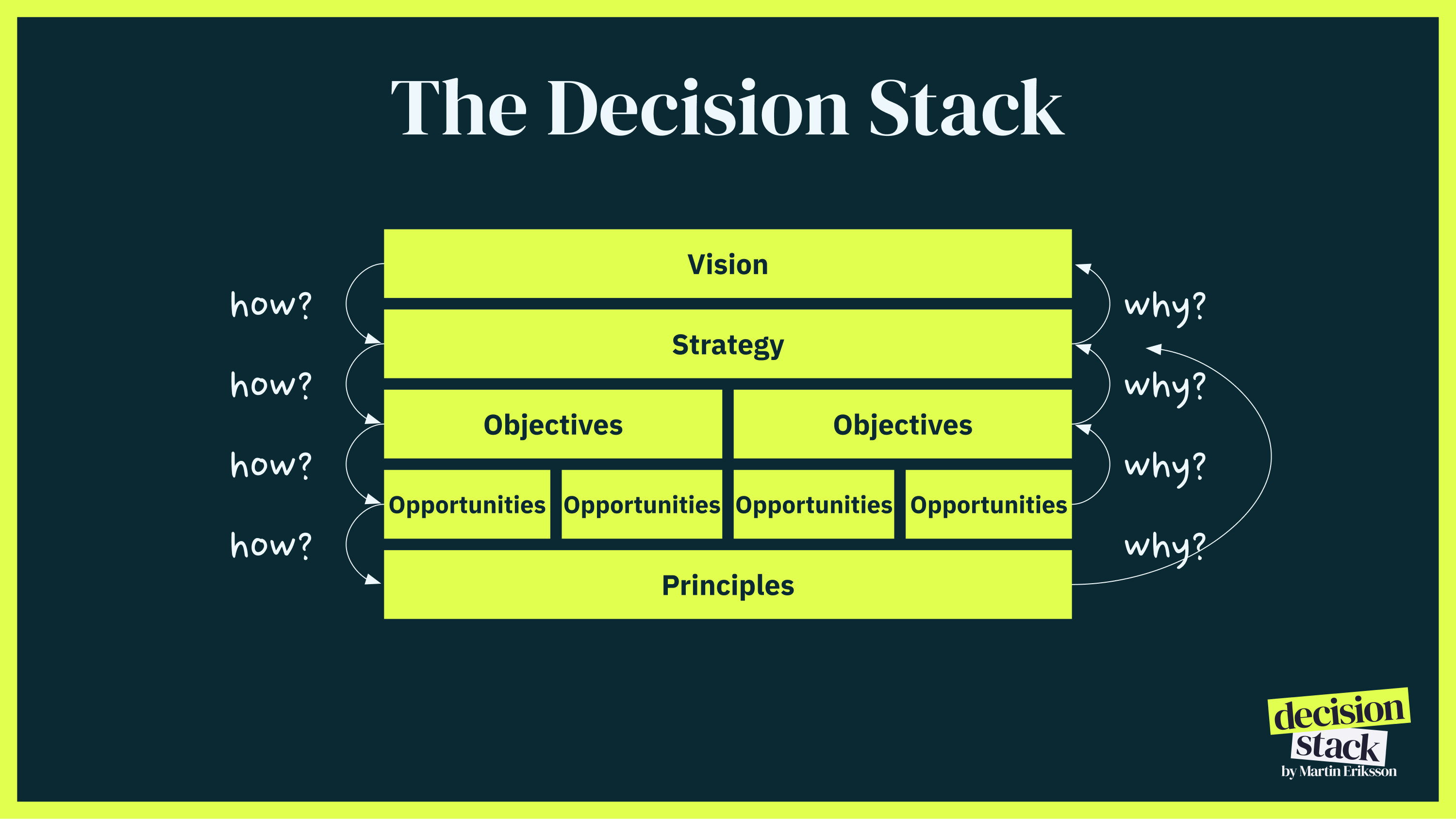
The how/why laddering breaks down. In my book The Decision Stack, I describe a simple test: read your stack from top to bottom, and every level should answer how. Read it from bottom to top, and every level should answer why. When drift has set in, teams can describe what they're doing but struggle to explain why it matters in terms of the strategy. They'll say things like "because leadership told us to" or "because it was on the roadmap" rather than connecting their work to a strategic rationale.
You have a graveyard of half-finished initiatives. Projects that were urgent last quarter are now quietly abandoned. Strategic priorities never got the sustained attention they needed. Opportunities were endorsed with enthusiasm, then starved of resources when something newer came along. If this sounds familiar, it's because a leader got excited, endorsed an initiative, mentally moved on because in their head the hard work was done, and then shifted attention when the next shiny object appeared. The team was left holding something that never got the air it needed to succeed.
Teams are busy, but the organisation isn't moving. Activity isn't the same as impact. Calendars are full, projects are delivered, and initiatives are launched. But without a connected stack, teams optimise for output over outcomes. They measure what they did, not whether it mattered. This is one of the clearest signs of drift: everyone is working flat out, and the organisation is still standing still.
The "strategy" has become a list of everything. When you ask different leaders what the strategy is and get different answers, that's a problem. When you ask and get a list of fifteen priorities, that's drift. Real strategy requires choices. It means choosing what you won't do as clearly as what you will. When a strategy has drifted, it's usually because it's accumulated new priorities without letting go of old ones. The hard "no" decisions stopped happening.
If you want to see what unchecked drift looks like over decades, look at the contrast between Kodak and Fujifilm. Both faced the same existential threat from digital photography. One drifted into irrelevance. The other adapted. I wrote about how Fujifilm survived what killed Kodak in a previous post.
How to Fix It
The good news is that fixing strategy drift doesn't require burning everything down and starting over. It requires reconnecting the dots.
Start with the how/why test. Pick any team's current work and try to trace it up through the stack. This feature addresses this opportunity, which serves this objective, which advances this strategy, which moves us toward this vision. Where does the chain break? That's where your drift started.
Go up before you go down. When you find disconnection, the instinct is to fix it at the level where you spotted it. Resist that. Go up the stack first. Check whether your strategy still holds. Check whether your objectives actually reflect that strategy. Drift at the bottom of the stack is almost always a symptom of something unclear or outdated further up. No amount of good execution at the bottom of the stack can compensate for an unexamined assumption at the top.
This is what Roger Martin means when he argues that strategy and execution are really the same thing. If your execution is drifting, the problem isn't discipline. The problem is that somewhere up the stack, a strategic decision is either missing, unclear, or no longer valid.
Make the change explicit. If you discover that the organisation has effectively pivoted without acknowledging it, name it. The problem isn't changing course. It's when leaders change course without telling anyone. Or worse, without admitting it to themselves. That's how you end up with teams executing yesterday's strategy while leadership has already moved on to tomorrow's. Update the relevant levels of your stack and re-establish coherence around the new direction.
Use the stack to say no. Drift often accelerates because organisations keep saying yes without saying no. Every new initiative, every new priority, every shiny new object gets added without anything being removed. The Decision Stack gives you the clarity to say no with confidence. When someone proposes an objective that doesn't serve your strategy, the stack makes that disconnect visible. You're not saying no because of politics or personal preference. You're saying no because the how/why laddering breaks. That's a structural fact, not a judgment call.
Paul Leinwand and Cesare Mainardi make a similar argument in Strategy That Works. Their first practice for closing the strategy-execution gap: commit to what you do best instead of chasing multiple opportunities. Drift is what happens when that commitment wavers.
How to Prevent It
Fixing drift after the fact is necessary but expensive. The real leverage is in preventing it from compounding in the first place.
Establish a review cadence. Different levels of the stack change at different rates. Your vision is more or less static. Your strategy might operate on a multi-year horizon. Your objectives shift quarterly. Your opportunities are in constant flux. But here's the key insight: review cadences should be more frequent than change cadences. The whole point is to catch drift before it compounds.
A practical rhythm: review your strategy and objectives together every cycle. Review your vision and principles annually. And review your opportunity landscape continuously, in every sprint review, every customer conversation debrief, every retrospective.
The review doesn't need to be heavyweight. A simple question will do: "Has anything changed that would make us rethink this?" If the answer is no, move on. If yes, you've caught something early. The cost of asking is minutes. The cost of not asking can be quarters of wasted effort.
Hone, don't transform. Geoff Tuff and Steven Goldbach use a great metaphor for this in their book Hone. Good chefs don't wait for their knives to become uselessly dull before fixing them. They hone regularly, keeping the edge sharp and fit for purpose. Honing is the antidote to drift. Without it, small misalignments accumulate until one day you wake up and realise you're miles from where you need to be, and now you need a costly transformation instead of a simple correction.
Distinguish signals from shiny objects. Every experienced team knows the pattern. A leader gets excited about a new opportunity. Suddenly, last quarter's priorities feel stale. Resources shift. And somewhere, a team that was heads-down executing on an agreed-upon plan discovers the organisation has moved on without them.
Here's a simple test: can you trace the new opportunity through the stack? If it connects to an existing objective and advances the current strategy, it might be worth pursuing. That's learning, not abandonment. If it requires a different strategy or serves a different objective, that's a bigger change. It might still be right. But it requires going back up the stack, revisiting those earlier decisions, and being explicit about what you're abandoning and why.
Empower everyone to spot it. The people closest to the work often see drift first. The support agent who notices the same question coming up repeatedly. The engineer who sees a technical capability that doesn't connect to any objective. The salesperson who keeps hearing feedback that contradicts a core assumption in the strategy. Leadership can't respond to information they don't have. If you're seeing something that doesn't connect, say so. The worst outcome isn't being wrong about the signal. It's staying silent while the organisation charges toward a cliff that everyone on the ground could see coming.
The Bottom Line
Strategy drift is inevitable. Every organisation will experience it. The question isn't whether it will happen to you, it's whether you'll catch it in weeks or in quarters.
The organisations that stay on course aren't the ones with perfect strategies. They're the ones with the discipline to keep checking whether things still connect. To ask "has anything changed?" regularly enough that the answer is usually "no." To hone rather than transform. And to be honest when the answer is "yes, and here's what we need to do about it."
Your strategy is probably drifting right now. The only question is whether you're going to notice before it's too late.
This post is adapted from concepts in my book The Decision Stack: How Strategic Clarity Builds Real Momentum. If you'd like help diagnosing drift in your organisation, get in touch.