


Every organization has a Decision Stack, whether you call it that or not.
It's the chain of decisions that connects your vision and mission, through your strategy and objectives, all the way down to the daily actions your teams take and the principles that guide how they work. When those decisions connect, teams move fast and make good calls without escalating. The whole organization builds momentum. When they don't connect (and in most organizations, they don't) you get smart people working hard in slightly different directions, burning energy on decisions that should be automatic.
The question isn't whether you have a Decision Stack. It's whether yours is a coherent whole or a disconnected mess.
Most leaders sense the problem. A Harvard Business Review study found that 95% of employees don't understand their company's strategy. But it's worse than that. Even when I ask leadership teams, the people who supposedly set the strategy, I get different answers from each executive. If the people defining the strategy can't agree on what it is, what chance do the teams executing it have?
The Problem Isn't Execution. It's Alignment.
Most organizations have some form of vision, strategy, and well-intentioned objectives. The problem is that none of it connects.
There's a vision, but the strategy doesn't clearly deliver it. There's a strategy, but the objectives don't map to it. There are objectives, but the teams' work doesn't ladder up to them. There are principles on the wall, but nobody uses them to make decisions.
This is why your organization can't build momentum. Your people are working hard. They're talented and committed. They're just all running in slightly different directions, burning energy on decisions that should be automatic.
When your Decision Stack is broken, the costs compound. Momentum suffers because every decision that should be obvious becomes a debate. Value suffers because teams optimize for output over outcomes, measuring what they did instead of whether it mattered. And morale suffers because there's nothing more demoralizing than working hard on something only to discover it wasn't what the organization or your customers actually needed.
Underneath all of this: decision fatigue. When there's no strategic clarity at the top, everyone drowns in decisions. The choices that should have been made once instead get made thousands of times, by hundreds of people, inconsistently. And when organizations feel this pain, they instinctively reach for more. More communication. More town halls. More OKRs. More alignment meetings. The answer is actually fewer, clearer, better-connected decisions.
Five Questions That Change Everything
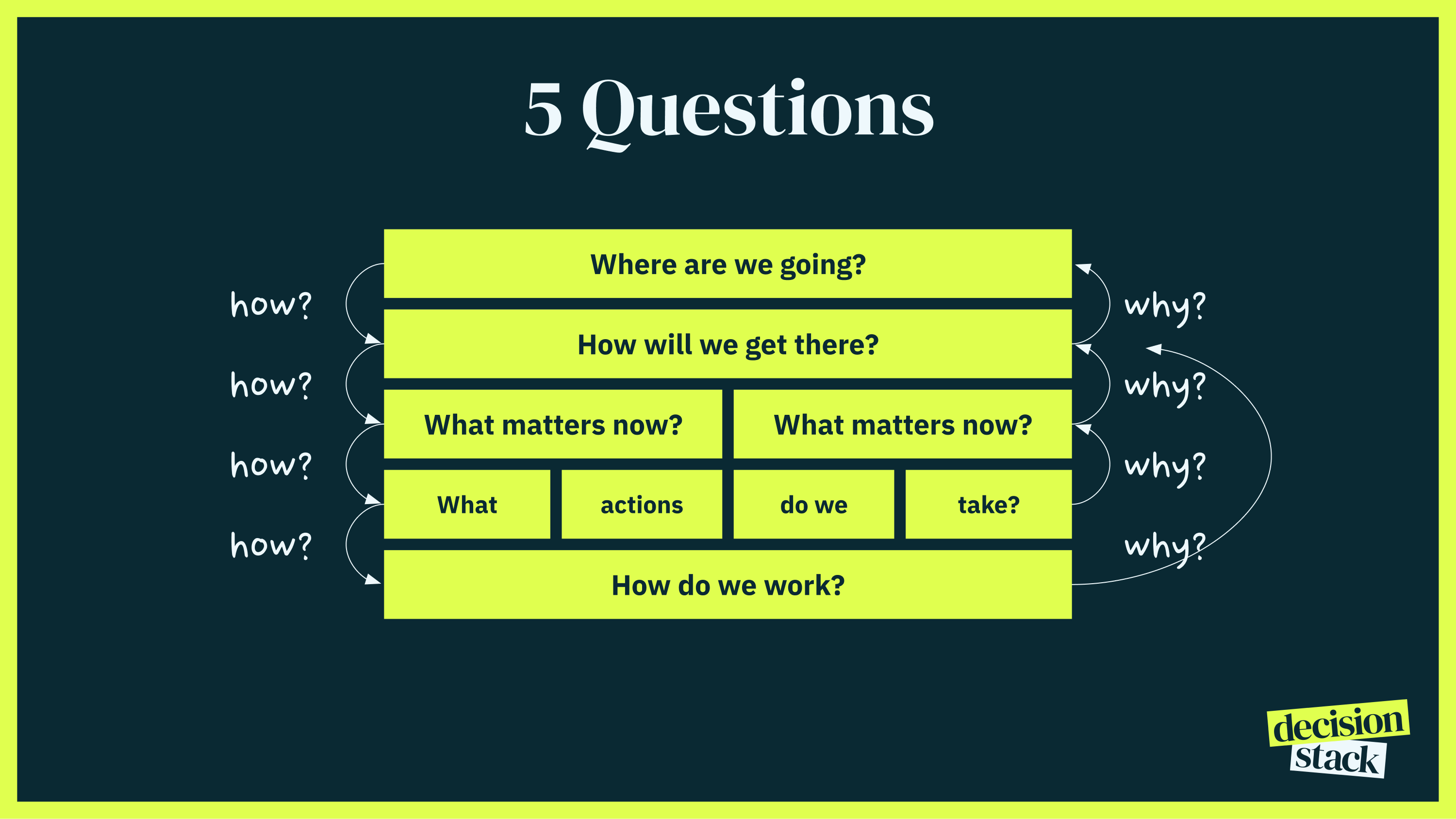
Every organization, at every level, needs to answer five fundamental questions:
- Where are we going?
- How will we get there?
- What's important right now on that journey?
- What actions are we taking to move forward?
- How do we make the right choices?
Simple questions. But walk through your organization and ask them, and you'll find a mess. Some people can answer the first one; there's usually a vision or mission statement floating around. Fewer can answer the second; strategy tends to be fuzzy or locked in leadership's heads. By the third, you're getting wildly different answers depending on who you ask. And by the fourth and fifth? People are just describing whatever work is in front of them, with no clear connection to anything above.
These five questions form a stack. Each answer should flow from the one above it, creating a clear line from the highest-level ambition to the smallest daily decision. When the stack is complete and coherent, decisions become easy. Teams know what to do without asking. Momentum becomes natural because clarity is built into the structure itself.
The Decision Stack: A Mental Model, Not a Framework
The Decision Stack is a mental model. A simplified picture of how decisions flow through your organization.
Think of it like the London Underground map. It's famously inaccurate geographically. The distances are wrong, the angles are wrong, the stations aren't where they'd be on a real map. But it's one of the most useful maps ever designed because it shows you what you actually need: how things connect, and how to get from where you are to where you want to be.
That's what the Decision Stack does. It's a lens for seeing how decisions connect, and where the connections are broken. It works alongside whatever you're already doing. You don't need to abandon your OKR system or your planning processes. The Decision Stack helps you see whether those tools are actually effective and connected, and where the gaps are.
How you answer each question matters less than making sure you have answers, and that those answers connect. That said, here's how I prefer to answer the five questions:
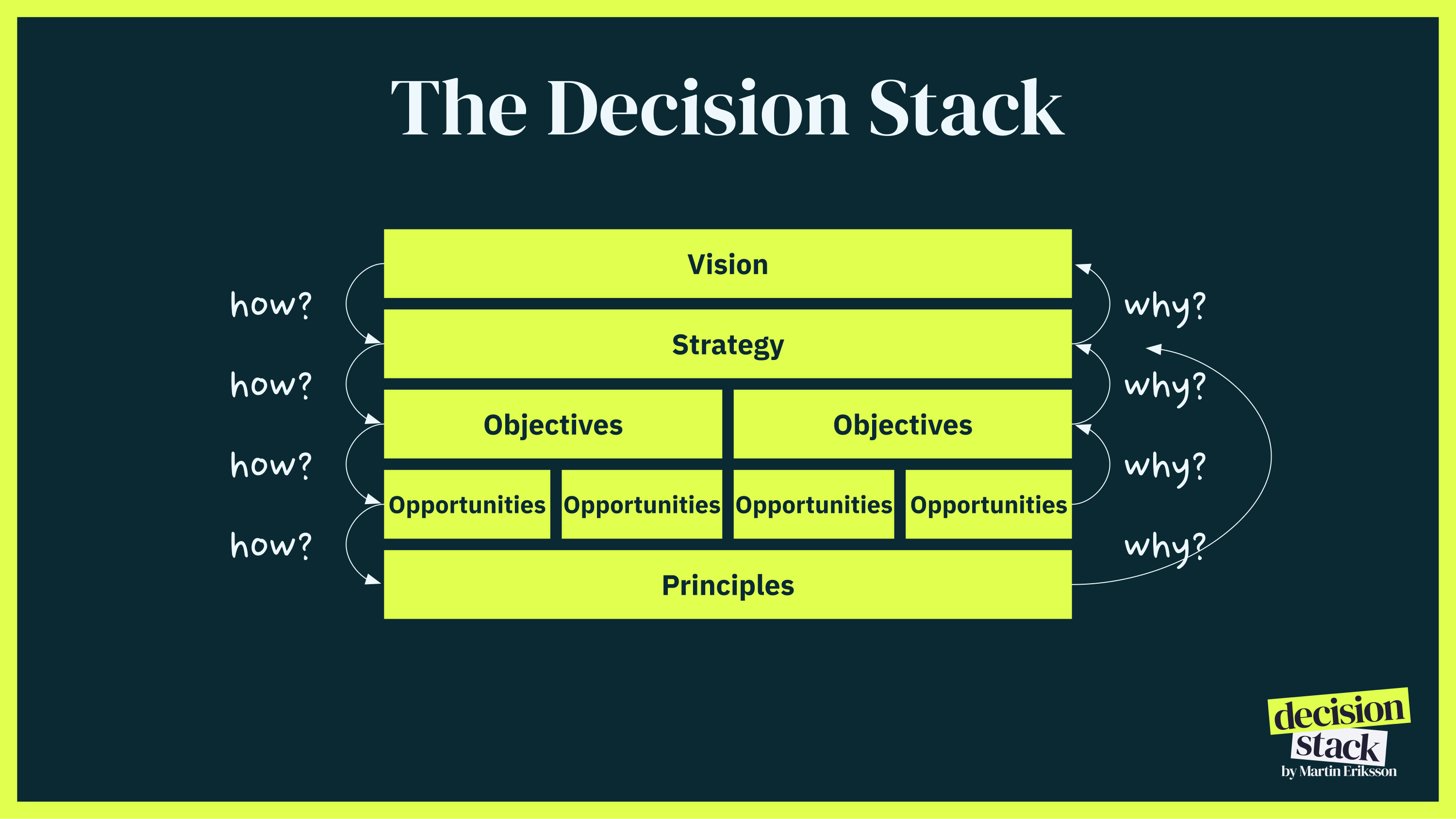
Where are we going? → Vision and Mission
Whether you call it mission or vision, separate them or combine them, every successful organization needs a clear sense of where it's going and why that matters. This is the top of the stack, the fixed point that everything else orients toward.
A strong vision motivates your team, attracts customers, and provides the ultimate test for every decision below it. When someone proposes a new initiative, the question becomes automatic: does this move us closer to where we're going?
The problem is that most visions are useless. They're generic, forgettable, and indistinguishable from every other company's mission statement. "To be the leading provider of…" tells you nothing. It helps no one make decisions. It motivates no one.
An effective vision is specific to your organization, customer-centric, and aspirational enough that you may never fully achieve it.
How will we get there? → Strategy
If your vision describes where you're going, strategy describes how you'll get there. It's the set of choices you make about where to play and how to win.
Most of what passes for strategy is actually just a list of priorities, or worse, a wishlist of everything the organization hopes to accomplish. Real strategy requires trade-offs. It means choosing what you won't do as clearly as what you will.
A clearly articulated strategy connects back to your vision, makes explicit choices about where you'll compete and where you won't, explains why those choices make sense given your current reality, and provides a coherent logic that connects your vision to the objectives your teams will pursue. And as Hermès and LVMH demonstrate, there's no single "right" strategy. There's only making a choice and committing to it.
What's important right now? → Objectives (and Key Results)
Strategy operates on a long time horizon. But your teams need to know what matters right now, this quarter, this month, this cycle. Objectives translate strategy into actionable focus for the immediate term.
Done well, objectives should describe outcomes, not outputs. Outputs are the things you do: features shipped, campaigns launched, deals closed. Outcomes are what changes as a result. An output can succeed without achieving anything meaningful. An outcome, by definition, moves you toward your strategic goals.
You don't have to use OKRs, though if you do, it's worth getting them right. What matters is that you have a clear answer to "what's important right now?" and that answer connects upward to your strategy and downward to the opportunities your teams pursue.
What actions are we taking? → Opportunities (and Solutions)
This is where the rubber meets the road. Given your objectives, what opportunities are you pursuing, and what solutions are you exploring to address them?
Notice the ordering: opportunities come first because they describe the landscape. The customer needs, pain points, and desires that, if addressed, would drive your objectives forward. Solutions come second because they serve specific opportunities. It's tempting to jump straight to solutions, but that skips a crucial step: understanding the opportunity space. For any given objective, there are many possible opportunities to pursue. The teams' job is to map that space, prioritise deliberately, and only then explore solutions, treating each one as a hypothesis to be tested rather than a commitment to be delivered.
How do we make the right choices? → Principles
This is the level most often completely missing in organizational strategy. It's about the principles that guide decision-making at the edges of your organization. The hundreds of small choices your teams make every day that you'll never see or approve.
Good principles crystallize the inherent trade-offs in your strategy. A brilliant way to express them is through "even over" statements: "Self-service even over white-glove support." "Speed even over perfection." "Jobseekers even over recruiters."
Your principles should be specific to your organization and your strategy. Generic values like "integrity" or "excellence" don't help anyone make decisions. Principles that articulate your unique trade-offs do.
How the Decision Stack Connects Vision to Action
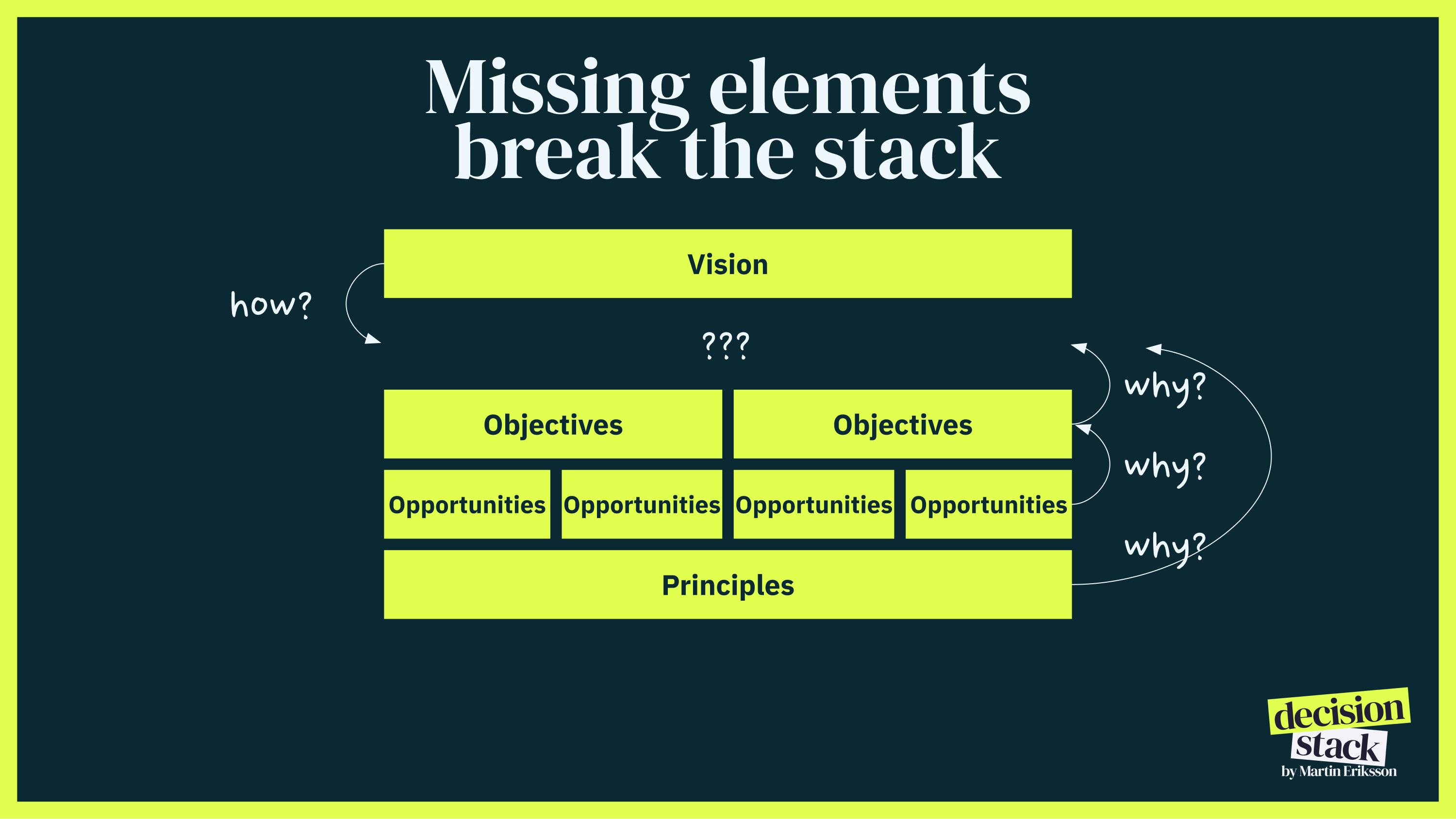
The how/why connection is the simplest and most powerful test of whether your stack is working.
Read the stack from top to bottom, and every level answers: How are we going to do this? Your vision answers how you'll change the world. Your strategy answers how you'll achieve that vision. Your objectives answer how you'll execute that strategy. Your opportunities answer how you'll achieve your objectives. Your principles answer how you'll approach the work.
Read it from bottom to top, and every level answers: Why are we doing this? Your principles exist because of the trade-offs inherent in your strategy. Your opportunities connect to specific objectives. Your objectives advance your strategy. Your strategy serves your vision.
When the laddering holds, you have coherence and clarity. Anyone in the organization can trace their work upward and understand why it matters. When it breaks, when you can answer "how?" but not "why?", or "why?" but not "how?", you've found exactly where the work needs to happen.
The beauty of this test is that anyone can use it. You don't need authority to ask "why does this matter?" You don't need permission to notice that the answers don't connect. The how/why laddering is a tool for everyone, from the people who set the strategy to everyone who has to execute it.
The Clarity to Say No
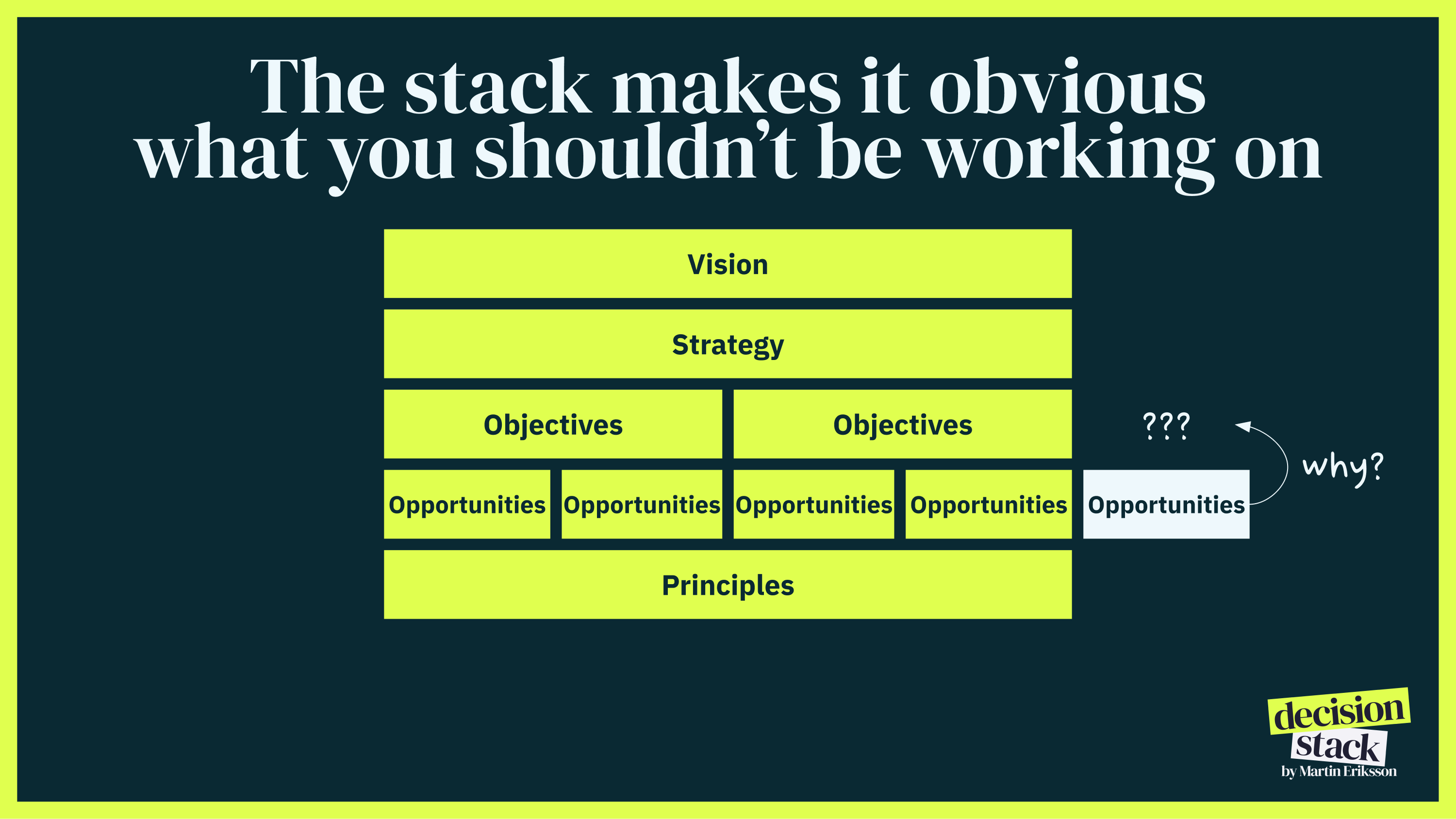
The Decision Stack isn't just about deciding what to do. It's a tool for deciding what not to do.
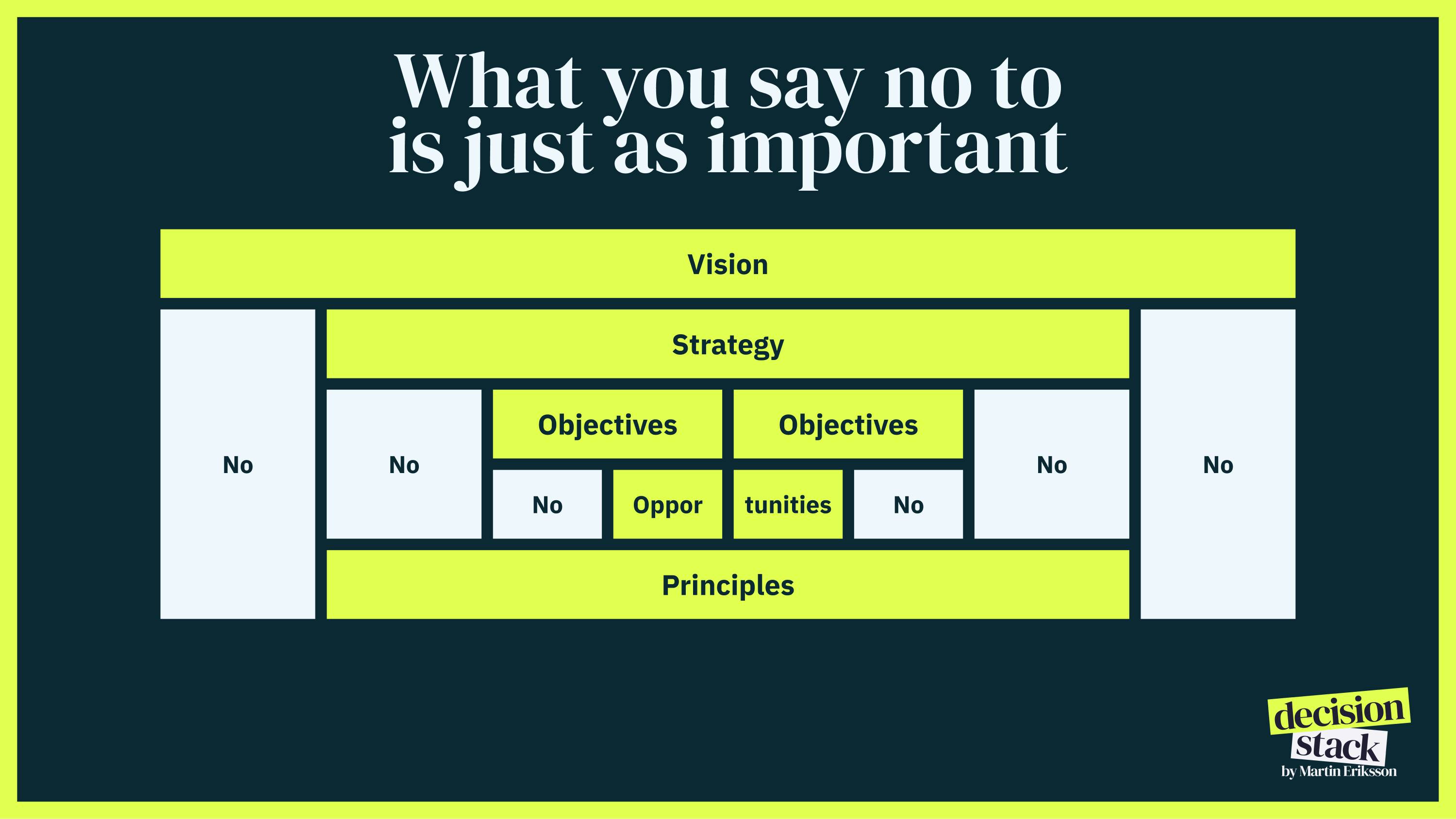
Every level of the stack is an integrated set of decisions. And decisions, by definition, mean saying yes to certain things and no to most. A vision that encompasses everything is no vision at all. A strategy that makes no trade-offs is just a wishlist.
When someone proposes an objective that doesn't serve your strategy, the stack makes that disconnect visible. You're not saying no because you don't like the idea, or because of politics. You're saying no because it doesn't connect. The how/why laddering breaks. That's a structural fact, not a judgement call.
What you say no to is often more important than what you say yes to. The most successful organizations aren't the ones that say yes to everything. They're the ones that say no to almost everything, but say yes with full commitment to the few things that matter. The Decision Stack is how you tell the difference.
Don't Start From Scratch
The good news? You don't need to tear everything down and start over. Every organization already has a Decision Stack. It's just a question of whether it's coherent or disconnected.
You simply need to inventory what you have, identify where the connections are broken, and start building the bridges that make good decisions possible. The real work isn't inventing new strategy or better OKRs. It's creating the connective tissue between what you already have.
Want to see what this looks like in practice? Read how Co-op uses the Decision Stack to align their teams, how Fujifilm's coherent stack saved them when Kodak's broke, or how Phantm turned their strategy into action using this model.
Go Deeper
The Decision Stack book covers each level of the stack in detail, with real-world examples, practical tools, and the connective tissue that makes it all work. Whether you're a founder, CEO, product leader, or anyone who cares about connecting strategy to execution, this is the book that shows you how.
Keep Reading
- How Empowered Is Your Team, Really? A Decision Stack Diagnostic
- Roger Martin Is Right: Strategy Is Broken. Here's How to Fix It.
- Does Every Team Need a Separate Strategy?
What Readers of the Book Say
The company stack is changing fast, and The Decision Stack outlines how we capture the momentum and make our ideas happen better and faster than ever before.
- Scott Belsky, Founder of Behance
Most companies don't have an execution problem — they lack sufficient shared context to execute quickly. The Decision Stack gives leaders a practical framework for sharing more context from the top.
- Christina Cacioppo, Founder of Vanta
In The Decision Stack, Martin Eriksson offers a compelling mental model for connecting vision to action — helping organizations move faster not by doing more, but by deciding better.
- Dr Edward Hoffman, former Chief Knowledge Officer at NASA
Martin's practical approach to connecting strategy, vision and goals is crucial to an aligned, empowered organization. Must read!
- Jeff Gothelf, Author of Lean UX
The Decision Stack is the fastest way I know to create clarity where there's confusion. This is an essential book for anyone who wants their teams to make better decisions, faster.
- Petra Wille, Author of Strong Product People
This book will show you how to build the kind of shared clarity that lets your entire organization move fast without falling apart. Read it before your next strategy offsite.
- Des Traynor, Co-Founder of Intercom